 CALL US: +91-8657407598


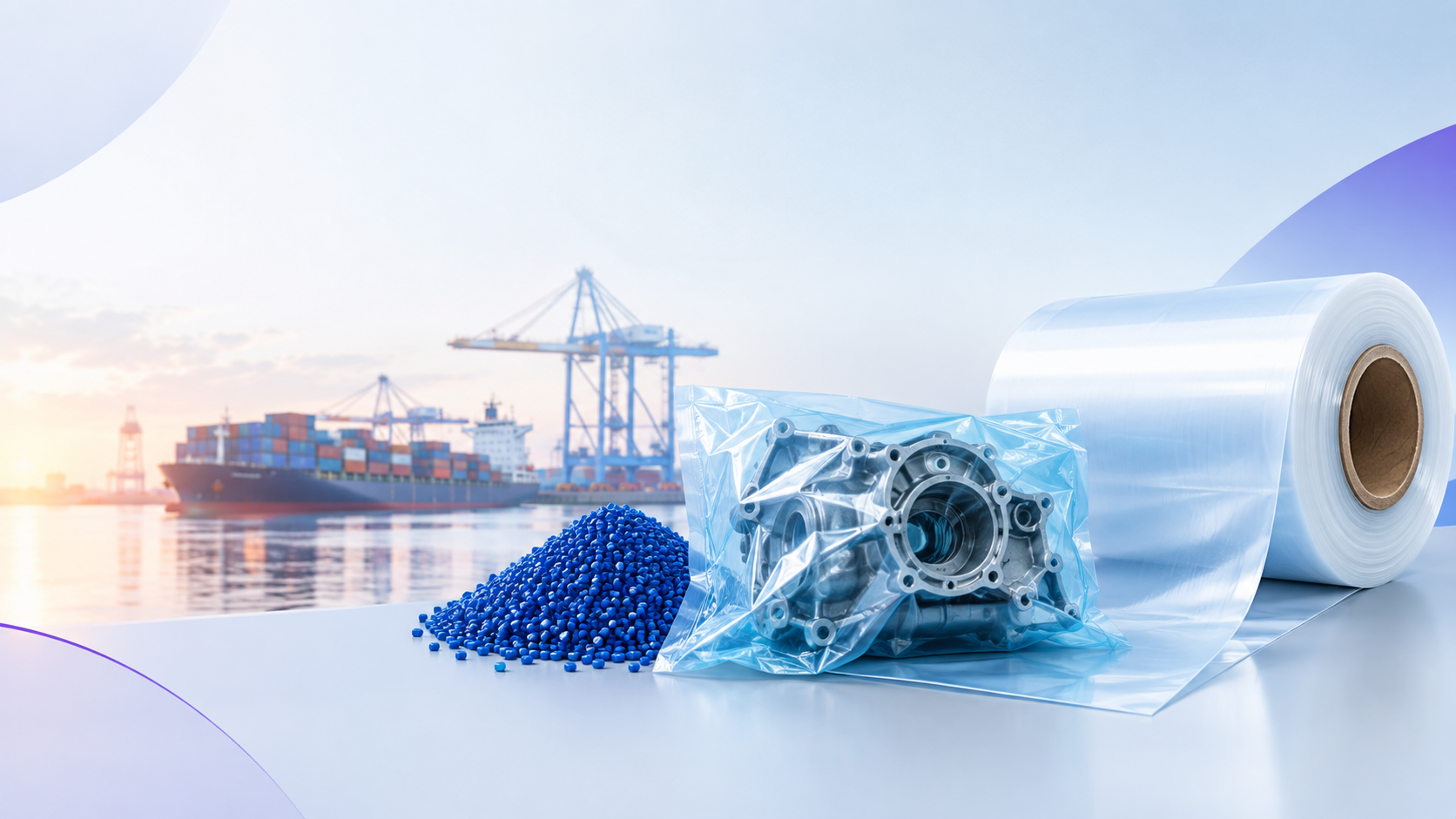
VCI Masterbatches: The Foolproof Strategy for Rust-Free Metal Export
Exporting high-value metal components—from automotive engine blocks and aerospace turbines to massive coils of cold-rolled steel—across oceans presents a serious corrosion-control challenge. Inside a shipping container, saltwater exposure, fluctuating temperatures, and extremely high humidity can create a "rain" effect known as container sweat.
Historically, manufacturers protected metal parts by applying thick Rust Preventative (RP) oils or Cosmoline. While these methods can be effective, they create a significant downstream bottleneck. Once the parts arrive, end-users may need to spend hours degreasing and cleaning the metal with solvents before the components can be assembled or processed.
Today, manufacturers and global exporters are increasingly turning toward dry, clean, and ready-to-use corrosion protection through VCI (Volatile Corrosion Inhibitor) packaging films.
For polymer engineers and film extruders, however, VCI presents a unique processing challenge. The same volatility that allows VCI chemistry to protect metal can also make it difficult to process without losing active ingredients.
This guide explores the physical chemistry behind VCI masterbatches, the thermal constraints involved in extrusion, co-extrusion strategies, carrier resin selection, and the compliance considerations involved in producing high-performance corrosion-protection films.
How VCI Chemistry Protects Metal
VCI does not simply act as a conventional moisture barrier. Instead, it works by modifying the environment surrounding the metal surface and reducing the conditions required for electrochemical corrosion.
When a VCI masterbatch is incorporated into polyethylene film—typically LDPE or LLDPE—the active compounds are distributed throughout the polymer matrix. Once a metal component is enclosed inside the finished VCI packaging, the active chemistry gradually migrates into the enclosed airspace and toward the metal surface.
Three Stages of VCI Protection
- Sublimation: Volatile corrosion-inhibiting compounds gradually migrate from the polymer matrix into the enclosed airspace inside the packaging.
- Adsorption: VCI molecules migrate toward the metal surface and form an extremely thin protective molecular layer.
- Electrochemical Protection: The protective molecules interfere with the electrochemical reactions responsible for corrosion by reducing the interaction of the metal surface with moisture and other corrosive species.
When the packaging is opened, the VCI concentration around the component decreases as the volatile compounds dissipate. This allows the metal surface to remain clean and generally avoids the heavy post-shipment cleaning associated with traditional oil-based corrosion protection.
The objective of VCI packaging is simple: protect the metal during storage and transportation without leaving a heavy protective coating that has to be removed before processing.
The Extrusion Challenge: Protecting the VCI Active
The volatility that makes VCI effective also creates one of the biggest challenges for film manufacturers.
VCI formulations contain volatile organic components that can become unstable, vaporize, or degrade when exposed to excessive processing temperatures. Depending on the chemistry and formulation, some VCI systems can become increasingly sensitive as processing temperatures approach approximately 160°C to 180°C.
If the extrusion process is not designed around the thermal characteristics of the VCI chemistry, a significant portion of the active material can be lost before the film even reaches the die.
Common Signs of Poor VCI Processing
- Die drool: Degraded or volatilized components can accumulate around the die lip, increasing cleaning requirements and causing production interruptions.
- Foaming and voids: Vaporization within the polymer melt can create bubbles, voids, and inconsistent film structure.
- Reduced mechanical performance: Poor processing can result in cloudy, weak, or easily torn film.
- Loss of corrosion protection: A film can appear visually normal while containing substantially less active VCI chemistry than intended.
The final problem can be particularly serious. A film may successfully pass visual inspection while failing to provide the required corrosion protection during a long-distance shipment.
Engineering a Better VCI Film
Producing reliable VCI film requires more than simply adding a corrosion inhibitor to polyethylene. The extrusion architecture, carrier resin, processing temperature, let-down ratio, and film structure all influence the final performance.
Why Multi-Layer Co-Extrusion Can Improve Efficiency
In a mono-layer VCI film, active compounds can migrate both toward the packaged metal and outward toward the external environment. The outward migration represents a loss of active chemistry and can reduce the efficiency of the formulation.
A multi-layer structure can be engineered to concentrate VCI where it is most useful while providing the mechanical and barrier characteristics required for industrial packaging.
A typical three-layer structure may include:
- Inner layer: Contains the VCI masterbatch and faces the protected metal component, allowing the active chemistry to migrate into the enclosed package environment.
- Core layer: Provides mechanical strength, puncture resistance, and film integrity. Metallocene LLDPE and other performance-oriented polyethylene grades may be considered depending on the application.
- Outer layer: Can be formulated without VCI and engineered to provide additional physical or barrier properties, helping reduce unnecessary outward migration of the active chemistry.
The exact layer construction should be determined according to the metal type, packaging geometry, required storage duration, film thickness, transportation conditions, and desired corrosion-protection performance.
Choosing the Right Carrier Resin
Carrier resin selection is another important consideration in VCI masterbatch design.
Using a carrier that requires unnecessarily high processing temperatures can expose the active chemistry to excessive thermal stress. Specialized low-melting or high-flow carrier systems can help the masterbatch disperse effectively while allowing processors to maintain appropriate extrusion conditions.
Depending on the formulation and application, carrier systems based on suitable polyethylene grades or EVA-type materials may be evaluated for their melt characteristics, compatibility, dispersion, and thermal processing window.
The objective is not simply to find the lowest possible processing temperature. The goal is to create a processing window in which the carrier melts and disperses effectively while minimizing degradation or premature loss of the VCI active.
Compliance Considerations for Global Export
For manufacturers supplying international markets, corrosion performance is only one part of the equation. Chemical composition and regulatory documentation can also influence whether a VCI formulation is suitable for a particular application or destination market.
Historically, some corrosion-inhibiting formulations relied heavily on nitrites and certain amine chemistries. Depending on the specific substances involved and the conditions of use, regulatory concerns can arise around nitrosamine formation and occupational exposure.
Modern B2B buyers increasingly request detailed documentation covering the chemical composition and regulatory status of additives used in their packaging materials.
Documentation Buyers May Request
- Nitrite status: Confirmation of whether the formulation contains nitrites and, where relevant, documentation supporting the formulation's intended occupational and application requirements.
- REACH compliance: Documentation addressing applicable European chemical registration and restriction requirements, including relevant SVHC considerations.
- RoHS compliance: Where applicable to the end-use and supply chain, documentation concerning restricted substances and heavy metals.
- Technical data: Recommended let-down ratios, processing temperatures, compatibility information, and application-specific performance data.
- Safety documentation: Relevant SDS and regulatory information for the masterbatch and its intended use.
Compliance requirements can vary according to the chemistry, application, market, and finished product. Therefore, regulatory claims should always be verified against the specific formulation and the latest applicable requirements rather than treated as universal statements for every VCI product.
From Corrosion Protection to Process Reliability
For exporters of precision metal components, corrosion is more than a cosmetic issue. Surface corrosion can affect appearance, dimensional requirements, downstream processing, and in certain applications the usability of the component itself.
That makes the quality of the VCI film an important part of the overall packaging system.
A reliable VCI masterbatch should therefore be evaluated across several parameters:
- Thermal stability during extrusion
- Dispersion within the carrier resin
- Compatibility with the selected polyethylene system
- Corrosion protection performance
- Required let-down ratio
- Film-processing behavior
- Storage and transportation requirements
- Applicable regulatory documentation
Optimizing these parameters together can help film manufacturers achieve more consistent production while maintaining the corrosion-protection performance expected by industrial exporters.
VCI Masterbatch Solutions from Flamingo Additives
At Flamingo Additives and Colourants LLP, VCI masterbatch solutions are developed with a focus on processing performance, corrosion protection, and application requirements.
Our VCI formulations can be developed for polyethylene-based film applications, with attention to thermal stability, dispersion, carrier compatibility, and the requirements of ferrous and non-ferrous metal protection.
For manufacturers evaluating a new VCI formulation, changing an existing masterbatch, or facing processing issues such as excessive die deposits, foaming, inconsistent dispersion, or inadequate corrosion protection, the formulation and extrusion conditions should be assessed together.
Are you experiencing processing problems during VCI film extrusion or looking for a formulation suitable for your export packaging application? Contact the technical team at Flamingo Additives to discuss your film structure, processing conditions, let-down ratio, metal application, and required corrosion-protection performance.
