 CALL US: +91-8657407598


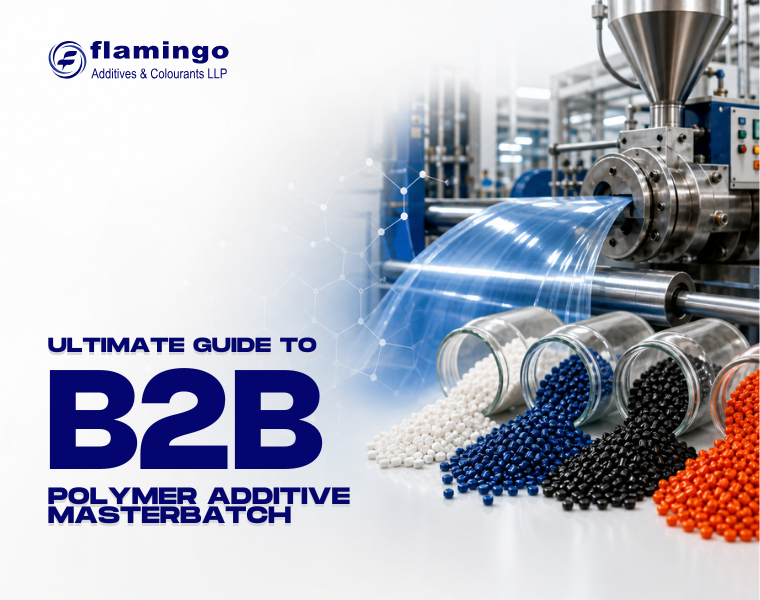
The Ultimate B2B Guide to Polymer Additive Masterbatches
In the modern plastics processing industry, margins are won and lost on the factory floor. Whether running high-speed blown film extrusion lines, precision injection molding, or specialized compounding, raw polymer resins are rarely sufficient on their own. To meet rigorous mechanical, aesthetic, and regulatory demands, manufacturers rely on polymer additive masterbatches.
However, treating masterbatches as a simple commodity is a costly mistake. The difference between a high-performance production run and a batch ruined by gel formation, color streaking, or poor dispersion lies entirely in the engineering of the masterbatch itself.
This comprehensive guide breaks down the science of additive masterbatches, how to select the correct carrier resins, and the technical specifications required to optimize your manufacturing processes.
What is an Additive Masterbatch? (Beyond the Basics)
At its core, a masterbatch is a highly concentrated mixture of pigments and/or functional additives encapsulated within a carrier resin during a heating process. It is then cooled and cut into a granular shape.
When processors add this concentrate to raw polymer (the let-down process) during manufacturing, it imparts specific properties to the final plastic product.
Core Additive Masterbatch Categories for Industrial Processing
To solve specific processing and end-use challenges, engineers deploy distinct chemical formulations.
1. Polymer Processing Aids (PPAs)
When extruding metallocene or linear low-density polyethylene (mLLDPE/LLDPE), processors frequently encounter flow instabilities resulting in melt fracture or "sharkskin."
The Mechanism: PPAs, typically formulated with fluoroelastomers, migrate to the die wall during extrusion, creating a microscopic slip coating.
The Result: This eliminates surface defects, clears die drool, and allows operators to increase line speeds without triggering flow instability.
2. UV Stabilizers and Absorbers
Plastics exposed to outdoor environments degrade rapidly due to photo-oxidation, leading to chalking, embrittlement, and color fading.
UV Absorbers: Chemicals like Benzophenones absorb harmful UV radiation and dissipate it as harmless thermal energy.
Hindered Amine Light Stabilizers (HALS): Instead of absorbing light, HALS act as radical scavengers, inhibiting the degradation process at the molecular level. For premium agricultural films and outdoor furniture, a synergistic blend of HALS and UV absorbers is the industry standard.
3. Slip and Anti-Block Additives
In flexible packaging, manipulating the Coefficient of Friction (COF) is critical.
Anti-Block Agents: Mineral additives (like synthetic silica or talc) create micro-roughness on the film surface, preventing layers from sticking together (blocking) during winding and storage.
Slip Agents: Migratory additives (like Erucamide or Oleamide) bloom to the surface of the polymer after extrusion, reducing friction so films can glide smoothly through high-speed packaging machinery (VFFS/HFFS).
4. Flame Retardants (FR)
For automotive, electrical, and construction applications, meeting strict flammability standards (such as UL 94 V-0) is mandatory. Modern compounding is shifting away from traditional halogenated flame retardants due to environmental concerns, making halogen-free flame retardant (HFFR) masterbatches crucial for future-proofing product lines.
The Secret to Flawless Extrusion: Carrier Resin Compatibility
The most advanced chemical additive is useless if it does not disperse evenly into your base polymer. Poor dispersion leads to agglomerates (clumps), which create weak spots in films or localized failures in molded parts.
The foundation of perfect dispersion is carrier resin compatibility.
Universal Carriers: Often based on EVA (Ethylene Vinyl Acetate), these are marketed as compatible with multiple resins. However, for highly technical applications, universal carriers can cause delamination or a drop in mechanical properties.
Polymer-Specific Carriers: For zero-defect manufacturing, the carrier resin of the masterbatch must closely match the Melt Flow Index (MFI) and chemical structure of the base polymer. If you are molding Polypropylene (PP), your masterbatch should utilize a PP carrier.
Navigating Global Compliance Standards
B2B buyers cannot source masterbatches blindly; regulatory compliance is a massive barrier to entry for export markets. High-quality masterbatch manufacturers must provide documentation proving compliance with:
FDA 21 CFR & EFSA: Strict migration limits for additives used in food contact packaging.
REACH and SVHC: European regulations ensuring formulations are free from Substances of Very High Concern.
RoHS 3: Critical for the electrical and electronics sector, restricting the use of heavy metals (lead, cadmium) and specific brominated flame retardants.
Optimizing Your Compounding Strategy
Choosing the right masterbatch is an engineering decision, not just a purchasing one. By prioritizing advanced dispersion technologies, precise carrier compatibility, and rigorous regulatory compliance, plastics processors can drastically reduce machine downtime, lower their cost-in-use, and elevate the quality of their final products.
Get the Right Masterbatch for Your Application
Looking to improve product quality, reduce downtime, or optimise your processing efficiency?
Contact Our Experts for tailored recommendations based on your application
