 CALL US: +91-8657407598


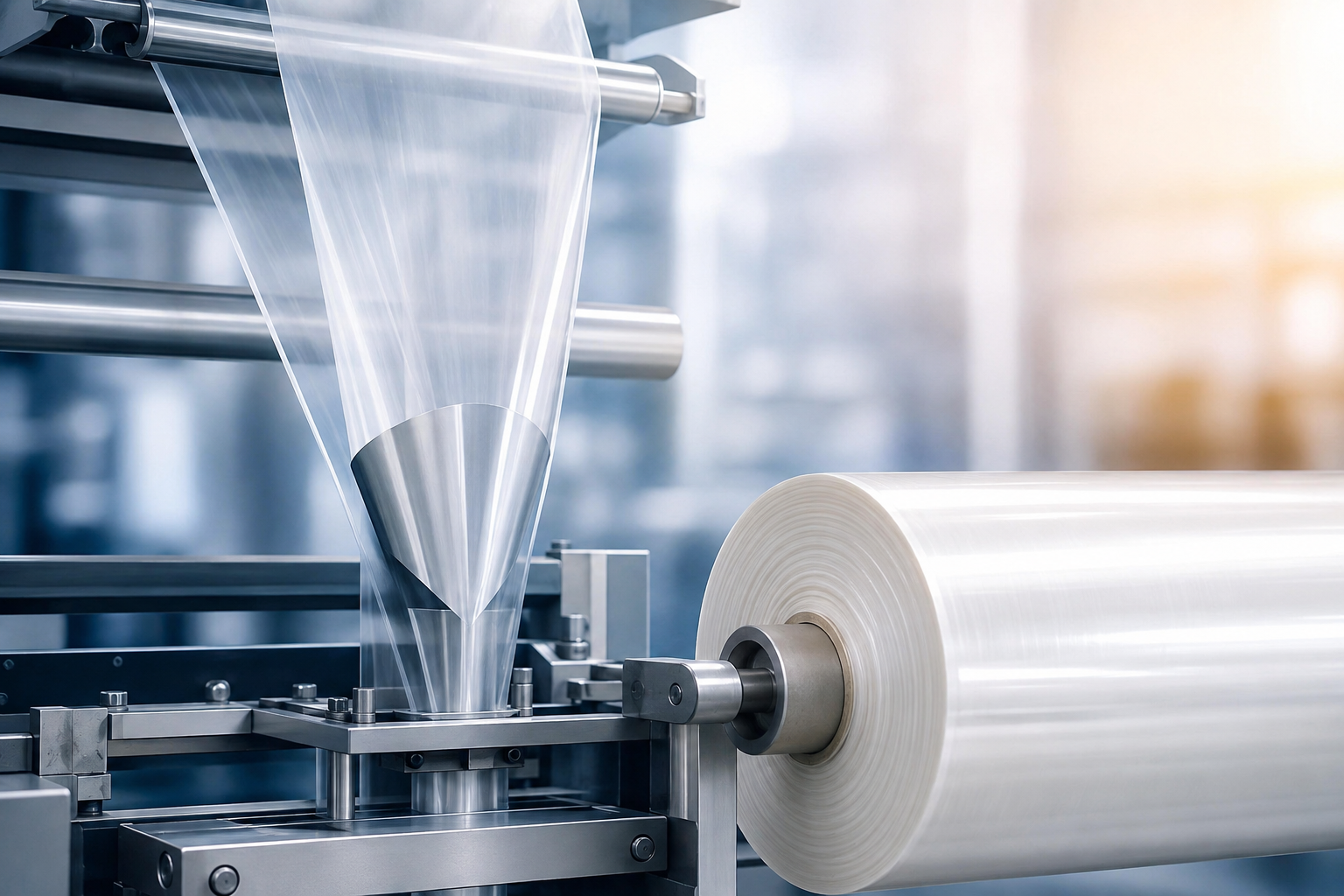
Slip vs. Anti-Block: Optimizing COF for High-Speed Flexible Packaging
In the flexible packaging industry, machinery speed is the ultimate metric of success. Whether you are running Vertical Form Fill Seal (VFFS) machines for snack pouches or Horizontal Form Fill Seal (HFFS) lines for shrink wrapping, your throughput is bottlenecked by a single physical property: Coefficient of Friction (COF).
When the COF of your polymer film is too high, the plastic drags against metal forming collars, causing the film to stretch, jam, or snap entirely. Furthermore, when the film is wound into a tightly packed roll, the layers can fuse together — a defect known as blocking.
To achieve low-friction packaging performance, extruders must carefully manipulate the surface chemistry of the film. However, a widespread engineering mistake is confusing Slip Agents with Anti-Block Additives. While both influence friction and handling, their chemical mechanisms, deployment strategies, and side effects are fundamentally different.
This guide breaks down the science of surface modification, the major additive chemistries, and how to engineer the right COF for high-speed flexible packaging.
The Core Defect: Blocking vs. Drag Friction
Before selecting a masterbatch, it is important to correctly diagnose the problem occurring on the production floor.
- Blocking (Film-to-Film Friction): Polyolefins such as Polyethylene (PE) and Polypropylene (PP) have naturally smooth surfaces. When wound onto a roll under high tension, adjacent layers can adhere to one another through close surface contact and intermolecular forces. When the converter attempts to unwind the roll, the film may stick, tear, stretch, or become difficult to process.
- Drag Friction (Film-to-Metal Friction): This is the friction encountered when the film slides over steel components, forming collars, guides, rollers, and sealing jaws at high production speeds.
Although these problems are related to surface behavior, they require different mechanisms to control them. In many applications, the optimum solution combines both anti-block and slip technologies.
Anti-Block Additives: The Physical Spacer
Anti-block additives primarily address the film-to-film sticking problem through a physical mechanism.
How Anti-Block Works
Anti-block masterbatches commonly contain inorganic microscopic particles. When dispersed throughout the polymer melt and incorporated into the finished film, some of these particles create tiny protrusions at the film surface.
This controlled micro-roughness reduces the actual area of contact between adjacent film layers. It also creates microscopic air gaps between the surfaces, helping reduce the tendency of the layers to adhere during winding and storage.
Choosing the Right Anti-Block Chemistry
The mineral used in an anti-block formulation can have a significant impact on both blocking performance and optical properties.
- Natural Silica and Talc: Cost-effective options that can provide effective anti-blocking performance. However, particle characteristics and refractive-index differences can increase haze, making them less suitable for applications where high optical clarity is critical.
- Synthetic Silica: A premium option for applications requiring a balance between anti-blocking efficiency and optical appearance. Carefully engineered particle size, purity, and morphology can deliver strong performance while minimizing the impact on film clarity.
- Calcium Carbonate (CaCO3): Often selected for cost-sensitive applications such as industrial liners and garbage bags, where optical clarity is less important than economical processing and blocking control.
Slip Additives: The Chemical Lubricant
While anti-block additives help separate adjacent film layers, they do not necessarily provide the lubrication required for film-to-metal contact on high-speed packaging equipment. This is where Slip Additives become important.
The Mechanism: Surface Migration and Blooming
Many conventional slip agents are migratory chemicals, including fatty acid amides.
During extrusion, the slip additive is dispersed within the polymer matrix. As the film cools and the polymer structure develops, the slip molecules gradually migrate toward the film surface. Over time, they form a microscopic lubricating layer that can substantially reduce the coefficient of friction.
This migration process, commonly called blooming, means that slip performance can change after extrusion. The final COF therefore depends not only on additive concentration but also on factors such as polymer type, processing conditions, film structure, temperature, storage time, and additive chemistry.
Fast Slip vs. Slow Slip
Selecting the appropriate slip chemistry is critical because the migration rate can influence both converting performance and downstream processing.
- Erucamide: Widely used as a migratory slip agent in polyethylene and polypropylene films. It provides effective lubrication as it migrates toward the surface and is commonly selected where relatively rapid development of slip performance is required.
- Oleamide: Generally migrates more rapidly than erucamide and can deliver quick reduction in surface COF. However, its faster migration profile can also influence long-term COF stability and downstream processes.
- Non-Migratory Siloxanes: High-performance siloxane-based technologies can provide durable slip characteristics and may be considered for demanding applications involving multilayer films, high temperatures, or specialized converting conditions.
The important point is that there is no universally "best" slip additive. The correct chemistry depends on the film structure, target COF, processing speed, storage conditions, printing requirements, and sealing process.
When Too Much Slip Becomes a Problem
It is tempting to assume that increasing slip additive concentration will always improve film performance. In practice, excessive slip can create significant downstream problems.
Because migratory slip agents accumulate at the film surface, excessive dosing can produce an overly lubricated or waxy surface. This can interfere with processes that depend on surface adhesion.
- Printability: Excessive surface migration can interfere with ink adhesion in flexographic and rotogravure printing, potentially contributing to poor adhesion, rub resistance, or ink transfer issues.
- Heat Sealing: Excessive surface additive concentration can interfere with seal formation and may contribute to weaker seals, depending on the film structure and sealing conditions.
- Lamination: Surface migration can also influence adhesive bonding in laminated structures, particularly when surface treatment and adhesive compatibility are not properly controlled.
The golden rule: COF should be optimized rather than simply minimized. The target is the lowest practical friction level that still maintains the required printability, sealability, lamination performance, roll stability, and overall converting efficiency.
Corona Treatment and Slip Must Work Together
One of the most important considerations in printed flexible packaging is the relationship between surface treatment and slip migration.
Corona treatment increases the surface energy of polymer films, improving their suitability for printing, coating, and adhesive bonding. However, migratory slip additives can gradually move back toward the treated surface after extrusion.
This means that corona treatment intensity alone cannot compensate for excessive slip migration. Film formulation, treatment level, aging time, and downstream processing conditions must be considered together.
Combi-Batches: Combining Slip and Anti-Block
For many flexible packaging applications, the most practical solution is to use both slip and anti-block technologies in a carefully balanced formulation.
A Slip + Anti-Block Combi-Batch combines the two mechanisms within a single masterbatch system. The anti-block component introduces controlled micro-roughness to reduce film-to-film contact, while the slip component migrates toward the surface to reduce friction during processing.
When properly formulated, the combination can deliver efficient COF control while reducing the amount of slip additive required to achieve the desired processing characteristics.
However, the formulation must be matched to the specific polymer, film thickness, layer structure, extrusion process, target COF, optical requirements, and downstream converting conditions. There is no universal combi-batch formulation suitable for every film.
Formulate for High-Speed Packaging with Flamingo Additives
In high-speed flexible packaging, COF needs to be engineered with precision. The correct balance of additive chemistry, concentration, particle characteristics, and migration behavior can make the difference between stable high-speed production and recurring problems such as difficult unwinding, film jams, poor printing, or inconsistent sealing.
At Flamingo Additives and Colourants LLP, our high-performance Slip and Anti-Block Combi-Batches are tailored to specific converting requirements. Whether you are extruding high-clarity BOPP for snack packaging or heavy-duty LLDPE collation shrink films, the formulation can be optimized around your target COF, optical requirements, printability, and processing conditions.
Are your VFFS lines experiencing problems due to high film friction? Contact the technical team at Flamingo Additives to evaluate your film formulation and optimize the surface chemistry for more reliable, high-speed packaging performance.
