 CALL US: +91-8657407598


Masterbatch Dispersant to Reduce FPV | Flamingo Additives
A spiking filter pressure value is rarely a filter problem. It's usually a pigment that never got properly wetted in the first place — and by the time it shows up on the FPV gauge, you've already burned through expensive organic pigment trying to force a dispersion that was never going to happen on its own.
If your team keeps chasing FPV excursions, dull color strength, or streaking in high-concentration color masterbatches, the fix usually isn't more mixing time. It's the wetting agent doing the work upstream of the extruder.
What's actually happening when FPV spikes
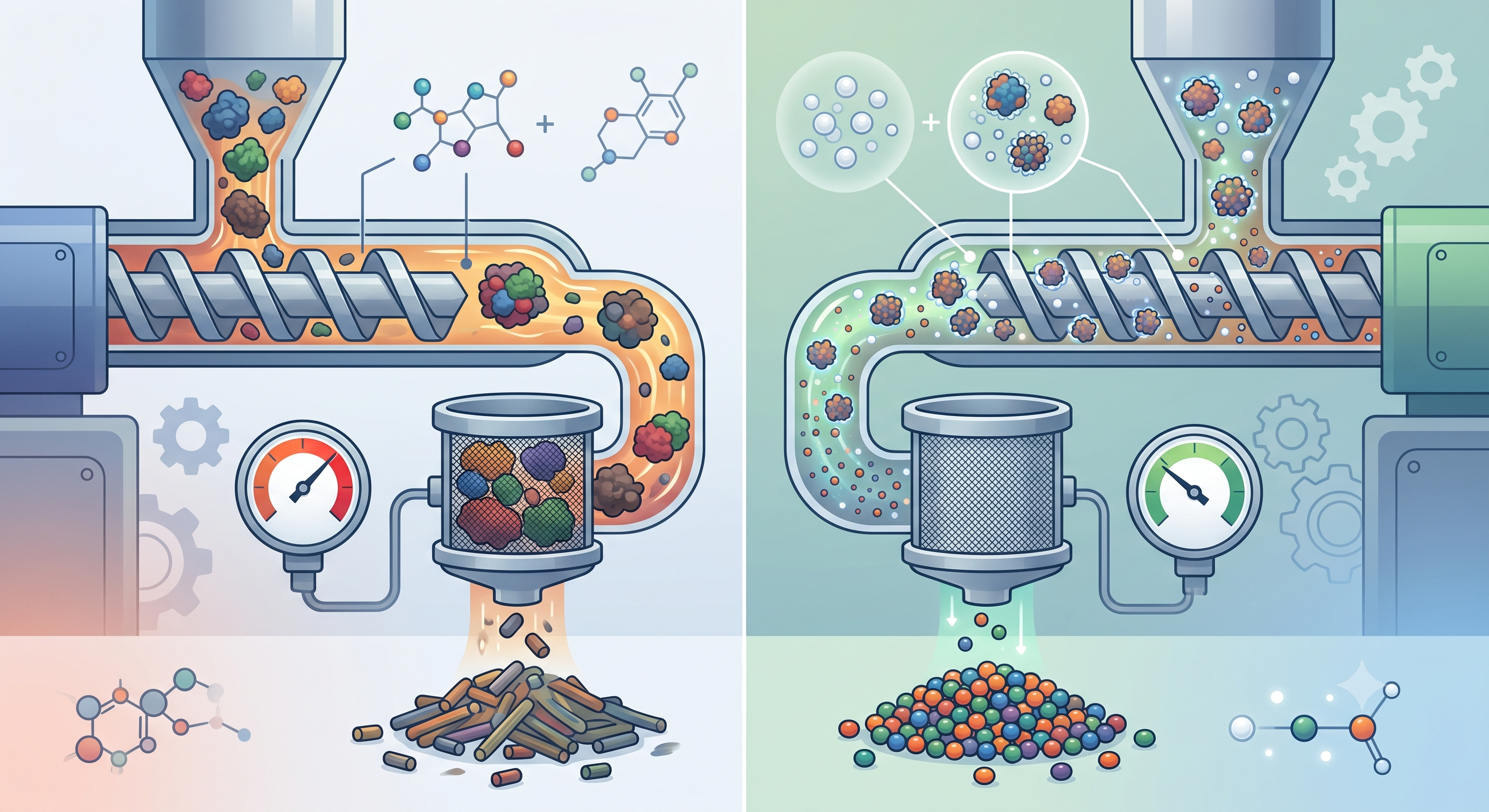
Filter pressure value measures how much undispersed material — pigment agglomerates, gel particles, contamination — is getting caught in a screen pack under controlled conditions. In color masterbatches, most of that resistance comes from pigment particles that never separated from each other during compounding. They clump, they resist the carrier resin, and they show up as pressure on the gauge and inconsistency in the final part.
Organic pigments are especially prone to this. Their particle surfaces are often incompatible with the non-polar polyolefin carrier resin, so without a wetting agent built for the job, a meaningful share of every batch stays agglomerated no matter how long it sits in the mixer.
Why this costs more than it looks like
Every agglomerate that fails to disperse is pigment you paid for and didn't get color strength from. Manufacturers compensate by loading more pigment to hit a shade target, which raises cost, increases FPV further, and often still leaves visible specks or streaks in the finished product.
Want to lower your FPV and get more out of your organic pigments? Request a sample of our premium dispersion waxes.
Where PE and EVA wax dispersants do the work
Non-oxidized PE waxes and EVA copolymer waxes function as wetting agents in the truest sense: they coat pigment particle surfaces during compounding, reduce interparticle attraction, and let the resin matrix actually surround each pigment particle instead of surrounding a clump of them.
- Faster, more complete pigment wetting during the compounding stage
- Lower melt viscosity at the point pigment needs to disperse, without permanently softening the finished pellet
- Measurably lower FPV at the same pigment loading, or equivalent FPV at a lower loading
- Higher effective color yield per unit of pigment, since less of it is trapped in agglomerates
- Smoother extrusion and reduced die buildup as a secondary benefit of better melt flow
Not every wax dispersant behaves the same way
The distinction that matters most in masterbatch work is between waxes built specifically as dispersing agents and general-purpose lubricant waxes pressed into service as a substitute. A purpose-built dispersion wax, like the type used in premium 110-series PE waxes, is selected for how it interacts with pigment surface chemistry — not just for melt point or hardness. That's the difference between a wax that quietly lowers FPV and one that barely moves the needle.
Quick answer: to reduce filter pressure value in a color masterbatch, add a non-oxidized PE or EVA copolymer wax formulated as a pigment dispersing agent — not a general lubricant wax — at the compounding stage, ahead of the pigment's melt-mixing point.
Get an FPV benchmark on your own formulation
Flamingo Additives supplies non-oxidized PE and EVA copolymer waxes engineered as dispersion aids for high-concentration color masterbatches.
Request a sample and technical consultation, and we'll help you benchmark FPV and color yield against your current dispersant.
