 CALL US: +91-8657407598


Lightweight Automotive Parts by 20% Using Chemical Foaming Agents
In the modern automotive industry, the engineering mandate is universal: reduce weight at all costs. For Internal Combustion Engine (ICE) vehicles, lightweighting is driven by stringent global emissions regulations such as CAFE standards. For the booming Electric Vehicle (EV) sector, the stakes are even higher. The massive weight of lithium-ion battery packs severely limits driving range. To compensate, automotive Tier 1 and Tier 2 suppliers are aggressively replacing metal components with engineering plastics.
However, simply switching to plastic is no longer enough. To achieve the next frontier of automotive lightweighting, processors must reduce the density of the polymers themselves.
The most efficient, scalable way to achieve up to a 20% weight reduction in injection-molded and extruded parts is the strategic deployment of Chemical Foaming Agent (CFA) Masterbatches.
This guide breaks down the complex thermodynamics of CFAs, the critical differences between endothermic and exothermic chemistries, and how to optimize your injection molding process to reduce sink marks while significantly lowering part weight.
The Mechanics of Microcellular Foaming
When a solid plastic part is injection molded, it is essentially 100% dense polymer. Chemical Foaming Agents alter this physical structure by creating a structural foam.
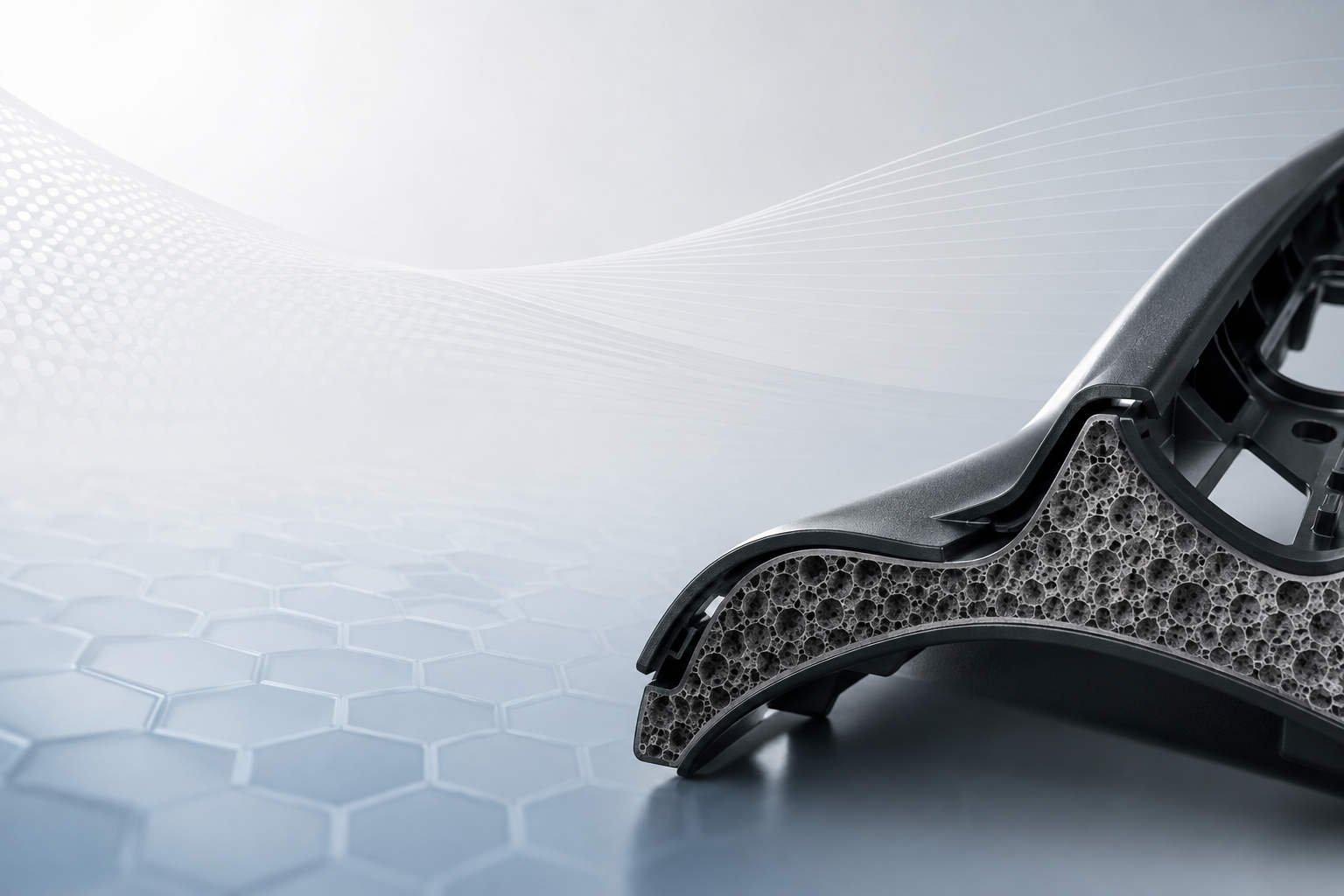
A structural foam part consists of a solid, high-density outer skin surrounding a lightweight, microcellular core.
How the Process Works Inside the Barrel
CFAs are chemical compounds encapsulated in a polymer carrier resin. When introduced into an injection molding machine or extruder, the CFA travels along the heated barrel. Once the barrel reaches the specific activation temperature of the foaming agent, the chemical decomposes, releasing gas such as Carbon Dioxide or Nitrogen directly into the polymer melt.
Under the immense pressure inside the barrel, this gas remains dissolved in the molten plastic.
The Expansion Phase in the Mold
The critical expansion occurs at the nozzle. When the gas-laden polymer is injected into the mold cavity, it experiences a sudden drop in pressure. This causes the dissolved gas to rapidly expand out of solution, forming millions of microscopic bubbles, or cells, within the core of the plastic part.
Because the polymer touching the cooler mold walls freezes first, it forms a solid outer skin, while the expanding gas creates a lightweight honeycomb-like structure inside.
Choosing the Right Chemistry
Treating all CFAs as the same is a critical engineering mistake. The choice of chemistry directly influences structural integrity, surface finish, processing speed, and achievable weight reduction.
Endothermic Foaming Agents
Endothermic CFAs, typically based on sodium bicarbonate and citric acid derivatives, absorb heat from the surrounding polymer during decomposition.
- Gas: Primarily Carbon Dioxide.
- Cell Structure: Fine, uniform, closed-cell structures.
- Advantage: By absorbing heat, they can help cool the polymer melt and reduce cooling and overall cycle times. They can also provide a smooth surface finish, making them suitable for visible automotive interior components such as door panels and dashboard trim.
- Limitation: They generally provide lower gas pressure than exothermic systems, which can limit maximum weight reduction, commonly to around 5% to 10% depending on the application and process.
Exothermic Foaming Agents
Exothermic CFAs, commonly based on chemistries such as Azodicarbonamide (ADC), release heat during decomposition.
- Gas: Primarily Nitrogen.
- Cell Structure: Larger, higher-pressure cells.
- Advantage: Higher gas generation can provide significant expansion force, making exothermic CFAs suitable for thick-walled automotive components, structural parts, and selected under-the-hood applications where weight reduction is the primary objective.
- Limitation: Excessive gas pressure can disrupt the surface skin and result in silver streaks or a rougher surface finish. Process conditions and formulation therefore need careful optimization.
The Engineering Sweet Spot: Synergistic Blends
For many automotive applications, an Endo/Exo Blend Masterbatch can offer a balanced approach. By combining both chemistries in controlled proportions, polymer engineers can leverage the gas-generation capability of an exothermic agent while using the characteristics of an endothermic system to help manage cell formation, cooling, and surface quality.
Beyond Lightweighting: Reducing Sink Marks and Cycle Time
While Tier 1 suppliers may initially adopt CFAs to reduce material consumption and component weight, the technology can also help address costly injection molding defects and improve production efficiency.
Reducing Sink Marks
As solid plastic cools inside a mold, it undergoes volumetric shrinkage. Components with complex geometries, varying wall thicknesses, or heavy reinforcing ribs are particularly susceptible to uneven shrinkage, resulting in visible dimples known as sink marks.
Traditionally, processors combat sink marks by increasing packing and holding pressure. While this can compensate for some shrinkage, it also consumes additional material and can increase internal stresses.
The CFA approach: As the foaming agent generates gas within the polymer melt, the expanding cells provide internal pressure that can help compensate for material shrinkage during cooling. With the right formulation and processing conditions, this can reduce sink marks while using less material.
Reducing Cycle Times
Because structural foaming reduces the amount of solid polymer required to fill the component and certain endothermic systems can contribute to heat removal, cycle time may be reduced in suitable applications. Actual cycle-time savings depend on the polymer, mold design, CFA chemistry, loading level, and processing conditions.
Process Optimization for Structural Foam
Achieving consistent, defect-free foaming requires careful adjustment of injection molding parameters. Simply adding a CFA to a conventional process is unlikely to deliver optimal results.
- Optimize Injection Speed: The polymer melt generally needs to fill the cavity rapidly enough to control premature gas expansion. Injection speed that is too slow can contribute to short shots, streaking, or inconsistent cell formation.
- Optimize Holding Pressure: Conventional packing and holding conditions may need to be substantially reduced or redesigned because excessive pressure can suppress foam expansion and reduce the intended lightweighting effect.
- Ensure Proper Mold Venting: Air and gases must escape efficiently from the mold cavity. Poor venting can contribute to burn marks, trapped air, surface defects, and inconsistent filling.
Engineer Lighter, Faster with Flamingo Additives
Achieving significant weight reduction without compromising impact strength, dimensional stability, or surface quality requires careful chemical and process optimization. Generic, off-the-shelf foaming agents may suffer from poor dispersion or inconsistent gas generation, resulting in variable part quality and production rejects.
At Flamingo Additives and Colourants LLP, our Chemical Foaming Agent masterbatches are engineered for demanding automotive applications. Whether you require an endothermic formulation for applications where surface quality is critical or an exothermic system for higher expansion in thick-walled components, we can help match the foaming chemistry, decomposition temperature, and carrier resin to your polymer and processing conditions.
Are you struggling to meet aggressive lightweighting targets or fighting persistent sink marks on complex automotive molds? Contact the technical compounding team at Flamingo Additives to discuss a customized CFA masterbatch solution for your next automotive production run.
