 CALL US: +91-8657407598


Amorphous Wax for Hot Melt Adhesives | Flamingo Additives
A hot melt adhesive that turns brittle the moment temperatures drop isn't a formulation edge case — it's one of the most common complaints polymer engineers bring to their wax suppliers, and it almost always traces back to one root cause: crystallinity.
If you've searched for ways to fix cracking, poor flex-crack resistance, or bond failure in cold storage, chances are the fix isn't in your tackifier or your polymer backbone. It's in the wax.
Why standard PE wax falls short in flexible formulations
Most polyethylene waxes used in hot melt systems are highly crystalline. Their molecular chains pack tightly into an ordered lattice, which gives them a sharp melting point and good hardness — useful properties in some contexts, but a liability in adhesives that need to flex, stretch, or bond to uneven substrates.
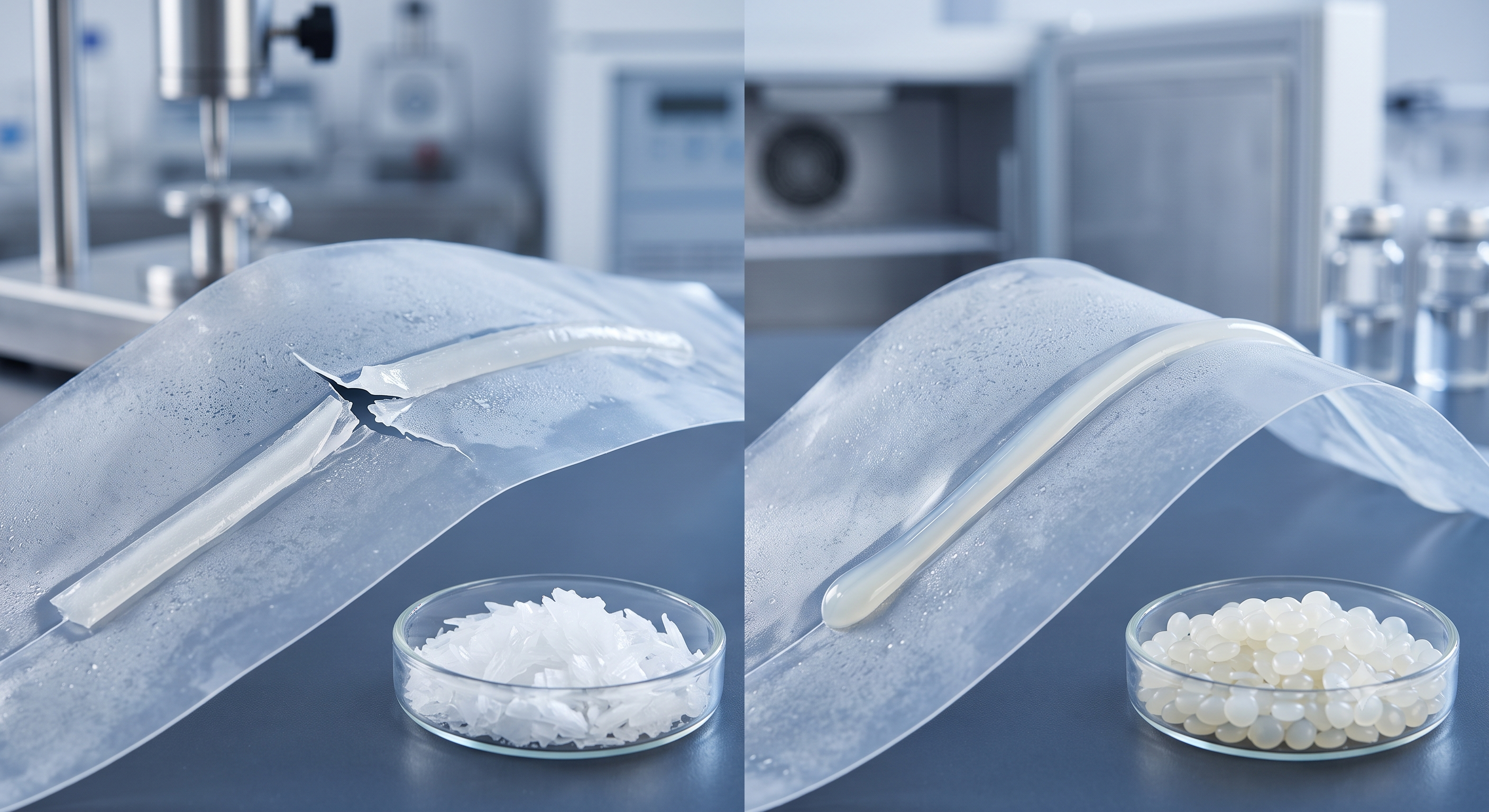
As a hot melt cools, that crystalline structure sets rigidly. Below a certain temperature, the bond line has nowhere to give. The result is exactly what shows up in the field: cracked seams on flexible packaging, delaminated labels in cold-chain logistics, and adhesive that snaps rather than flexes when a substrate moves.
The comonomer that changes the outcome
Ethylene alpha-olefin copolymer waxes interrupt that packing. By copolymerizing ethylene with an alpha-olefin comonomer, the resulting chain has short branches that disrupt the regular lattice a homopolymer PE wax would otherwise form. Less order means less crystallinity — and a wax that stays amorphous, or close to it, across a much wider temperature range.
Struggling with brittle hot melts? Ask Flamingo Additives about our highly amorphous specialty copolymer waxes.
What amorphous structure actually buys the formulator
The practical benefits of lower crystallinity show up at every stage of the adhesive's life, from the melt tank to the finished bond:
- Improved wetting on the substrate, since a less ordered wax flows and conforms more readily at application temperature
- Retained flexibility well below room temperature, reducing brittle failure in cold-chain and outdoor applications
- Stable, longer open tack time, which gives production lines more tolerance for line-speed variation
- Better compatibility with elastomeric and polar tackifiers commonly used in flexible hot melt systems
Amorphous wax vs crystalline PE wax: what changes in the adhesive
The distinction isn't just academic. A crystalline PE wax will typically raise hardness and set speed but does so at the cost of low-temperature flexibility and can even cause the adhesive to look hazy or feel waxy at the bond line. An amorphous ethylene alpha-olefin wax trades a small amount of that set speed for a bond that stays pliable, resists cold-crack, and holds tack over a broader service window.
For formulators optimizing an existing system, this is often the single variable worth testing first before reworking the polymer or tackifier package — it's a smaller formulation change with an outsized effect on cold-weather performance.
Where this matters most
Flexible packaging that ships through variable climates, footwear and textile lamination, nonwoven hygiene assembly, and any bond line exposed to movement or cold storage are the applications where amorphous wax chemistry earns its place fastest. If your current hot melt is specified for year-round or cold-region use, this is very likely where the next performance gain is hiding.
Quick answer: to improve flexibility in a hot melt adhesive without reformulating the whole system, replace or blend in an amorphous ethylene alpha-olefin copolymer wax in place of, or alongside, a conventional crystalline PE wax.
Talk to a formulation chemist
Flamingo Additives supplies Viscowax 9103, a highly amorphous ethylene alpha-olefin copolymer wax purpose-built for flexibility and low-temperature stability in hot melt adhesives.
Request a technical data sheet or a sample of Viscowax 9103 and we'll help you run it against your current wax in a side-by-side bond test.
